%20-%20All%20Logos_Primary%20-%20Full%20Color.png)
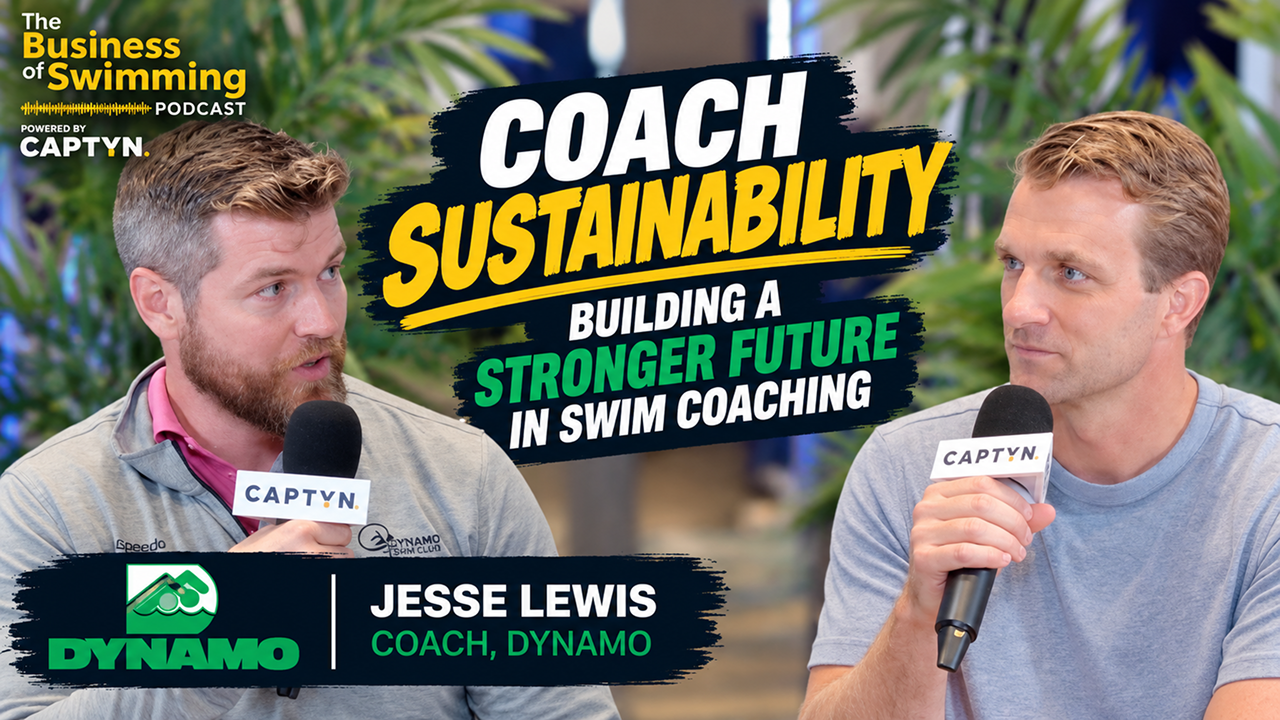
Making Coaching a Sustainable Career: Jesse Lewis on Retaining Great Swim Coaches



Swimming asks a lot from its coaches.
Early mornings, late evenings, weekend meets, travel, parent communication, administrative work, and professional development—the hours can add up quickly. For coaches who love the sport, giving that time can feel worthwhile. But passion alone doesn’t necessarily make coaching a sustainable career.
Live from the 2026 ASCA World Clinic, the Business of Swimming sat down with Jesse Lewis of Dynamo to discuss his work as an ASCA Fellow studying one of the most important challenges facing the industry: How do we keep great coaches in swimming for the long haul?
For Jesse, the question goes beyond compensation. It’s about creating careers that allow coaches to give their best to the sport without sacrificing everything outside of it.
When Passion Starts to Feel Like “Paid Volunteerism”
Coaches give an enormous amount back to swimming.
They’re responsible for athletes and families while also supporting fellow coaches, attending clinics, serving on committees and boards, and contributing to the broader swimming community.
Eventually, Jesse says, coaches can find themselves asking how much they have left to give to their families, friends, and interests outside the pool.
That pressure has contributed to talented coaches stepping away from the deck or leaving the profession entirely.
“At the end of the day, it’s a job,” Jesse said. “And sometimes as coaches we feel like it’s paid volunteerism.”
That tension became a starting point for the ASCA Fellows’ work on coach sustainability.
Understanding Why Coaches Leave
Jesse and his fellow ASCA Fellows weren’t starting from scratch.
Their work built on previous research, including a 2022 ASCA Fellows project examining coach attrition and a more recent swim coach compensation survey.
One trend was particularly important: coaches were already leaving the profession before the pandemic. COVID accelerated the problem, but it didn’t create it.
Compensation data also helped quantify something many coaches already felt—that the demands of the profession and what coaches receive in return don’t always feel balanced.
The challenge then became figuring out what swimming organizations could actually do about it.
Creating a Playbook for Coach Sustainability
One outcome of the Fellows’ work was a playbook of practices designed to help organizations retain great coaches over the long term.
That matters because many swim clubs effectively operate as small businesses without the infrastructure a traditional company might have.
There may be no HR department. Compensation packages may be informal. In some cases, coaches may not even have comprehensive employment contracts or clearly defined career paths.
The Fellows wanted to identify practical standards that organizations could use to create a more sustainable environment for their staff.
But they also recognized that there isn’t a one-size-fits-all solution.
Learning From Clubs That Keep Coaches for Decades
A large swim organization and a small community club don’t necessarily have access to the same resources.
Jesse’s group looked at both.
They examined larger organizations, smaller clubs, differences in demographics and athlete populations, and additional programs such as swim lessons.
Then they asked another important question:
Which clubs are already doing this well?
The group interviewed organizations that had successfully retained coaches for long periods of time. In some cases, staff members had remained with the same organization for 10, 15, or nearly 20 years.
The specific strategies varied, but the underlying result was the same: greater staff stability.
Coach Retention Is Also Athlete Retention
Keeping good coaches isn’t only an employment issue. It directly affects swimmers.
When a club continually changes coaching staff, athletes are repeatedly introduced to new cultures, terminology, expectations, and training philosophies. Even when the incoming coach is excellent, there’s still a learning curve.
That interrupts continuity.
“If you don’t have the consistency with your team culture, you don’t have the consistency on deck, the kids are gonna be the ones feeling the impact the most,” Jesse explained.
Eventually, some of those athletes may move to another team—or leave swimming altogether.
That makes coach sustainability a business issue, a performance issue, and an athlete-retention issue at the same time.
Building a Lifelong Connection to Swimming
The conversation also turned to how Dynamo approaches athlete development and retention.
Dynamo’s Junior Swim League gives younger athletes a pre-competitive entry point into swimming while leaving room for other sports and activities. The goal isn’t necessarily to force children to specialize early. It’s to keep them connected to the water and give them an opportunity to develop a genuine love for swimming.
Jesse has seen multisport athletes eventually choose swimming and go on to compete collegiately.
But the bigger objective isn’t simply producing college swimmers.
He wants athletes to look back and remember the lessons they learned, the relationships they formed, and the experiences they shared around the pool—even while they pursued other sports, music, and interests outside swimming.
Stronger Clubs Start With Sustainable Careers
Swimming will always attract passionate coaches.
The challenge is making sure the sport doesn’t rely on that passion as a substitute for building sustainable careers.
If clubs can provide better structures, clearer expectations, stronger professional support, and environments where talented coaches want to stay, the benefits extend throughout the organization.
Coaches can build careers instead of simply enduring workloads. Clubs gain continuity and institutional knowledge. Athletes develop within more stable cultures.
And swimming has a better chance of keeping great people on deck for decades rather than losing them along the way.
Coach sustainability isn’t separate from the future of swim clubs. It’s one of the foundations of it.
More Ways to Explore Captyn

Demo
See Captyn in action by exploring top features and watching a free demo of the platform

Success Stories
See how organizations of all sizes are operating and growing their businesses on Captyn

Live Events
Meet up and chat with us at one of the many live events we sponsor and attend all across the country